Launchspy

Guide

Funnel hacking: how to reverse-engineer any coach's funnel

Funnel hacking means studying a competitor's funnel closely enough to understand why it works: the ad that brings people in, the page they land on, the offer, the price, the follow-up. For coaches and course creators it is the fastest way to learn what a market already pays for. Everything you need is public by construction: the ad has to sit in Meta's archive, the page has to load in your browser, the checkout has to tell your browser what it is. Below is the full manual method, what to write down, how to tell whether a funnel actually converts, and real coaching funnels taken apart.

Updated Oct 20, 2026

AdMetaLandingopt-inVSL32 minCheckout$497Upsell+$197PIXELS DETECTEDMetaGA4TikTokSTACKClickFunnelsStripeThe manual version of this takes 20 to 40 minutes per funnel, and you have to alreadyknow whose funnel is worth walking.
What a mapped funnel looks like · steps, stack and pixels in one view

What funnel hacking is, and what it is not

A funnel is the path from a stranger seeing an ad to that stranger paying. Funnel hacking is walking that path yourself, on purpose, and writing down every decision the seller made: the promise in the ad, the first page, what they ask for (an email, a phone number, an application), what they sell, at what price, and what happens to people who do not buy.

It is not copying. Lifting someone's copy, video or design word for word is a copyright problem and, in a small coaching niche, a reputation problem. What transfers is the structure: a free training that sells a call, a quiz that segments before the offer, a low-priced entry product that funds the ads. Structures are not protected, and they are what you actually need.

Why coaches and course creators do it

Coaching offers are sold on trust and on a sequence, not on a product page. Two coaches with the same expertise can see very different results because one sends ads to a webinar and a call, and the other sends them to a sales page nobody reads. Studying funnels that keep running tells you which sequence your market responds to before you spend on testing it.

  • High-ticket coaching is usually sold on a call: the funnel exists to fill a calendar, not a cart.
  • Course launches lean on webinars and masterclasses: the funnel exists to get people to show up live.
  • Lower-priced programs often use a video sales letter (VSL) straight to checkout.

The 8-step funnel hacking method

  1. 01Open the Meta Ad Library and search the advertiser by page name. Every ad they run on Facebook and Instagram is there, including the ones they started this morning.
  2. 02Read the start date printed on each ad. An ad still live after a few months is one they keep paying for; those are the funnels worth walking first.
  3. 03Click through to the landing page from the ad itself, not from a search engine. Some funnels serve a different page depending on where the click came from.
  4. 04Walk every step and write down what happens: opt-in, VSL, application form, calendar, order bump, upsell, downsell. Go all the way to the payment page without paying.
  5. 05Note the offer: what is sold, at what price, and whether the page shows the price at all. No price and a calendar at the end means the sale happens on a call.
  6. 06View the page source and search for pixel signatures: fbq for Meta, gtag for Google, ttq for TikTok. They tell you which platforms they retarget on.
  7. 07Look at the page builder and the checkout domain. They usually name the platform outright: kajabi, clickfunnels, systeme, thrivecart, hotmart, skool.
  8. 08Subscribe with a throwaway address and keep the emails. The sequence after opt-in is half the funnel and almost nobody documents it.

Use a private window and a clean profile. Your own retargeting cookies change what some funnels show you.

What to write down at each step

A funnel you walked but did not document is a funnel you will misremember in a week. Use the same sheet for every one, so you can compare them side by side later.

  • The ad: hook (first line or first three seconds), format (video, image, carousel), call-to-action button, start date.
  • The landing page: headline, the single action it asks for, what proof it shows, what platform it runs on.
  • The capture: what they ask (email, phone, application questions) and what you get in return.
  • The offer: name, format (program, coaching, community), price and payment options, how it is sold (checkout or call).
  • The tools: page builder, booking tool, payment processor, tracking pixels.
  • The follow-up: the emails or texts you receive in the next seven days, and when.

How to know if a funnel converts

You will never see a competitor's conversion rate. You can see the decisions of someone who does. Meta does not publish spend or results for commercial ads, but it does publish when each ad started, and an advertiser pays for every day an ad stays live. An ad still running after months is one they keep choosing to fund.

The second signal is repetition: several versions of the same ad running at once usually means the advertiser is scaling something that works, not testing from scratch. The third is persistence of the offer: the same price and the same promise across several months of ads. A funnel that keeps all three is worth your time; a funnel that changes every two weeks is still being figured out.

The three coaching funnels you will meet most

Webinar or masterclass: the ad sells a free live (or recorded) training, the registration page collects an email, the training ends on an offer, often a call. Watch for countdowns and replay pages.

Video sales letter (VSL): the ad sends to a page built around one long video with a buy button under it. Watch where the button goes and whether the price appears on the page.

Book-a-call: the ad sends to a short page or an application form that ends on a calendar. A booking tool on the page (iClosed, Calendly and similar) is the clearest sign of a high-ticket offer sold by a closer.

Real coaching funnels, taken apart

Behind the ads of US coaches in our data we analyzed 359 webinar, 71 VSL, 85 book-a-call funnels (counted Oct 20, 2026). Of the 366,511 coaching ads live in our index, 26% have been running for 90 days or more (measured Oct 20, 2026). Here is what the method above looks like on real ones, read from the pages themselves.

Webinar funnel

by John C. Maxwell

  1. 1 · The ad

    Ad by John C. Maxwell

    Running 5 days

    Meta Ad Library
  2. 2 · The page

    go.maxwellleadership.com

    It Only Takes One Leadership Series | Maxwell Leadership Certified Team

  3. 3 · The offer

    1 step

    Landing page

    No price shown on the page

  4. 4 · The tools

    Hubspot_cmsStripe

Try it on a page now

Paste any landing page. The stack detector reads it and tells you the platform, the pixels, the payment tools and the kind of funnel, the step you would otherwise do by reading the page source.

Try

Funnel hacking checklist

A 10-point sheet to keep next to you while you walk a funnel. Enter your email and it opens here.

By continuing you agree to our Privacy Policy.

Where the manual method stops working

  • It takes 20 to 40 minutes per funnel, done properly, and you have to already know whose funnel to walk.
  • You see today. You cannot see that they doubled their ad count three weeks ago, or that this offer replaced a cheaper one in March.
  • You cannot compare. Knowing one competitor charges $497 is useless without knowing what the rest of the niche charges.
  • Ad creatives expire from your view. Meta keeps the archive, but the media behind old ads stops loading, so the ones that made them their money are the ones you can no longer study.
  • It does not scale past a handful. Mapping a niche means walking 50 funnels, which is a week of work that is stale by the time you finish.

How LaunchSpy does the same thing

  • Funnels already mapped, with their steps, pixels, landing stack and payment stack
  • The ads that drive each funnel, sorted by run time, kept with their media even after Meta stops serving it
  • History: when an offer launched, when the ad count moved, who started scaling in the last 30 days
  • Offer prices seen on the pages, next to what the rest of the niche charges
  • Search by niche, country and platform, so you start from a market rather than a name
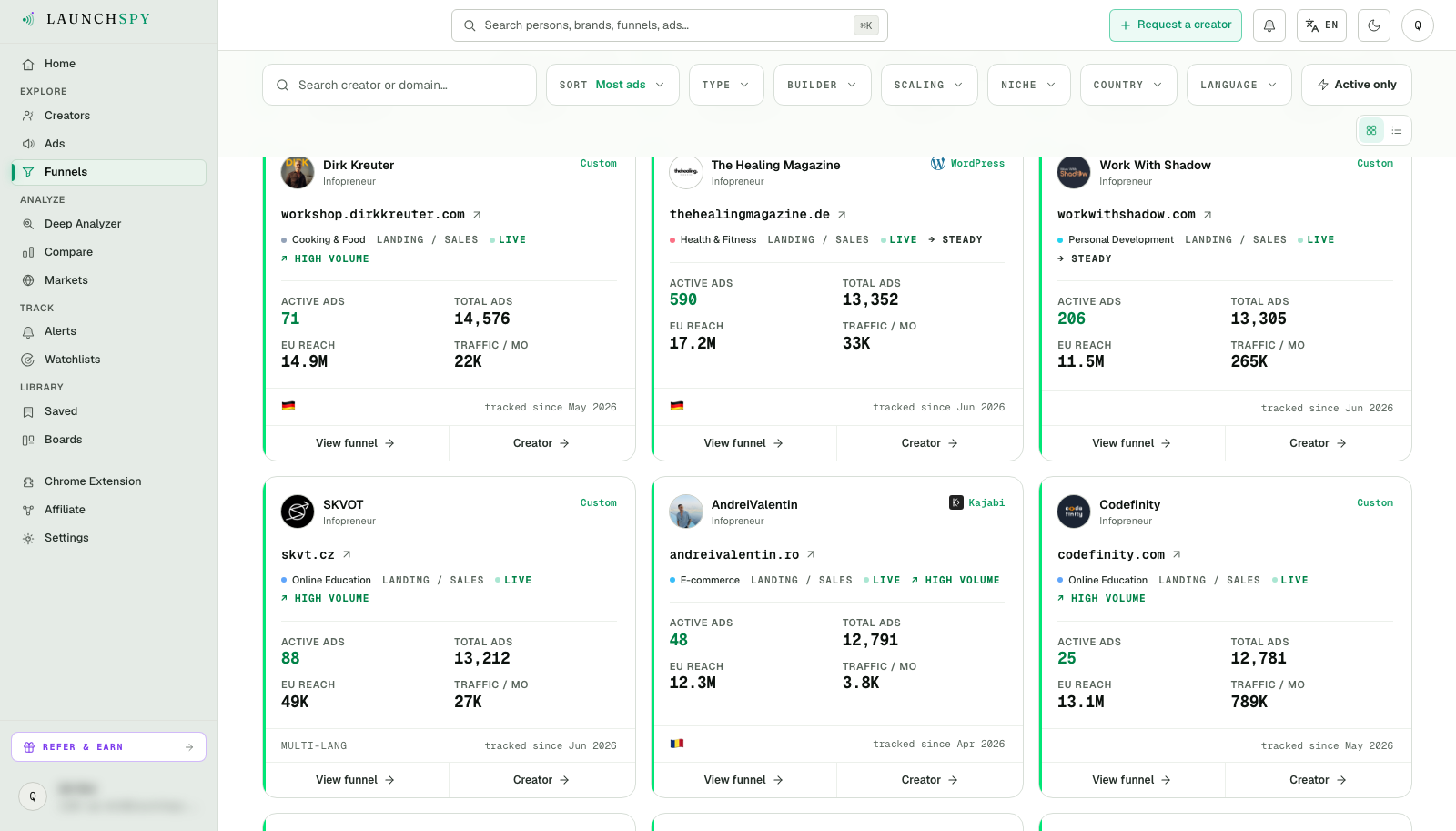
app.launchspy.io/dashboard/funnels
The LaunchSpy funnels directory, showing tracked funnels with their builder and ad volume
254,891 funnels already mapped · every landing page, its builder, its ad volume and its EU reach

Questions people ask

Is funnel hacking legal?

Yes. You are browsing public pages and a public ad archive that Meta is legally required to publish. Copying their copy or their creative wholesale is a different matter: that is a copyright question, and the answer there is no. Study the structure, write your own words.

How long does it take to funnel hack a competitor?

Done properly by hand, 20 to 40 minutes per funnel, plus a week of watching the follow-up emails. With a tool that has already mapped the funnel, a few minutes.

What tools do you need?

For the manual method: the Meta Ad Library, a private browser window, the page source view and a spare email address. A stack detector saves the source-reading step; LaunchSpy adds the ads, the steps and the history in one place.

How do I know if a funnel converts?

Look at run time. Meta publishes the start date of every ad, and an advertiser pays for every day it stays live. Ads running for months, several versions of the same ad at once, and an offer that stays the same across months are the strongest public signs that a funnel works.

How do I find the funnel if they do not run ads?

Check their link in bio, their pinned post, and the footer of their site. Creators who do not buy traffic usually funnel from organic content, so the entry point is a lead magnet rather than an ad.

Why does the landing page look different from the ad?

Either they are split testing, or the page adapts to the traffic source. Always click from the ad itself, in a private window.

Do this for a whole niche, not one page at a time

105,000+ creators · 18.6M+ ads · 420,000+ funnels · 51 platforms · 10 markets

Start free

Related guides