Gross, not profit. The platform takes a fee, ads cost money, refunds happen · and the community is often the cheapest thing that creator sells.
The free method, step by step
- 01Open the community page. Member count and price are usually both visible without joining.
- 02Multiply members by monthly price. That is your gross monthly floor.
- 03Deduct free members. Many communities run a free tier next to the paid one, and the public count often includes both.
- 04Check whether the price shown is monthly or annual. An annual price presented per month roughly halves what you should assume about churn.
- 05Look at the activity feed. A community with 900 members and three posts a week is churning hard, whatever the headline number says.
- 06Check whether Skool is the whole business or the back end of something bigger. Many creators use it to deliver a course sold elsewhere, so the community price is not the offer price.
- 07Look for their ads. A community growing on paid traffic behaves very differently from one growing on organic.
This gives you gross, not profit. Skool takes a platform fee, ads cost money, and refunds happen.
Where this stops working
- One community at a time, by hand, and the number is stale as soon as you write it down.
- No trend. Members today tells you nothing about whether that is up from 400 or down from 2,000.
- No context. Whether 600 members is good depends entirely on the niche, and you cannot see the niche from one page.
- It misses the rest of the business. The community is often the cheapest thing they sell.
- You still have to find the communities worth looking at, and Skool has no discovery built for that.
How LaunchSpy does the same thing
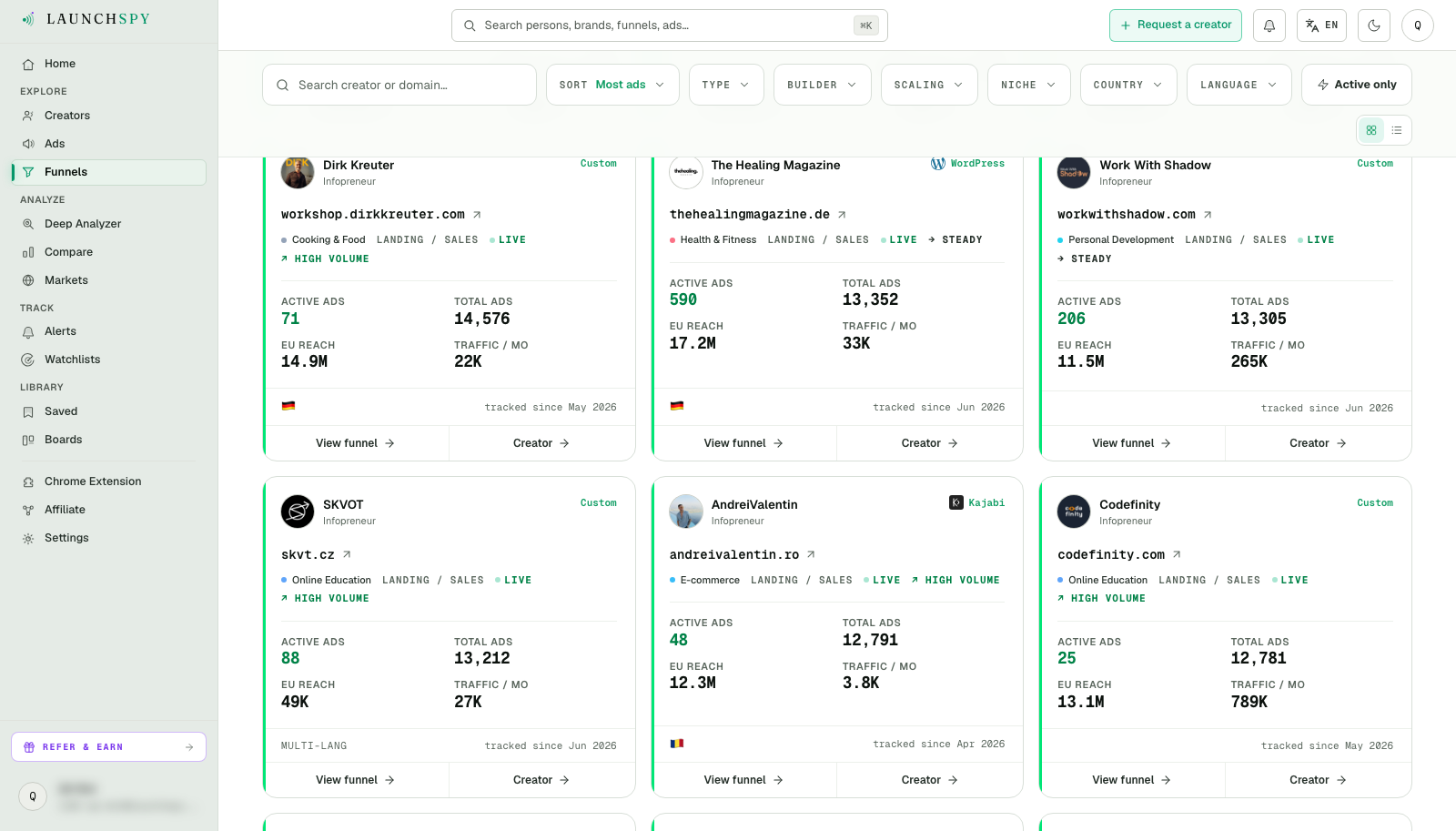
- Skool creators indexed alongside everything else they sell, on every other platform
- Their ads, so you can tell paid growth from organic growth
- Niche and country context, so a member count means something
- Activity signals · who started scaling in the last 30 days
- The funnel in front of the community, not just the join page
Questions people ask
Is the member count on a Skool page accurate?
It is accurate as a count, but it usually mixes free and paid members. Treat it as an upper bound on paying members, not a revenue figure.
Does Skool publish revenue?
No. Any revenue number you see for a community is an estimate built from members and price. Anyone presenting it as fact is overselling it.
What is a healthy size for a paid community?
It depends entirely on price. A hundred members at $99 is a better business than a thousand at $9, and far easier to keep alive.
Do this for a whole niche, not one page at a time
175,000+ creators · 16.1M+ ads · 330,000+ funnels · 51 platforms · 10 markets
Start free